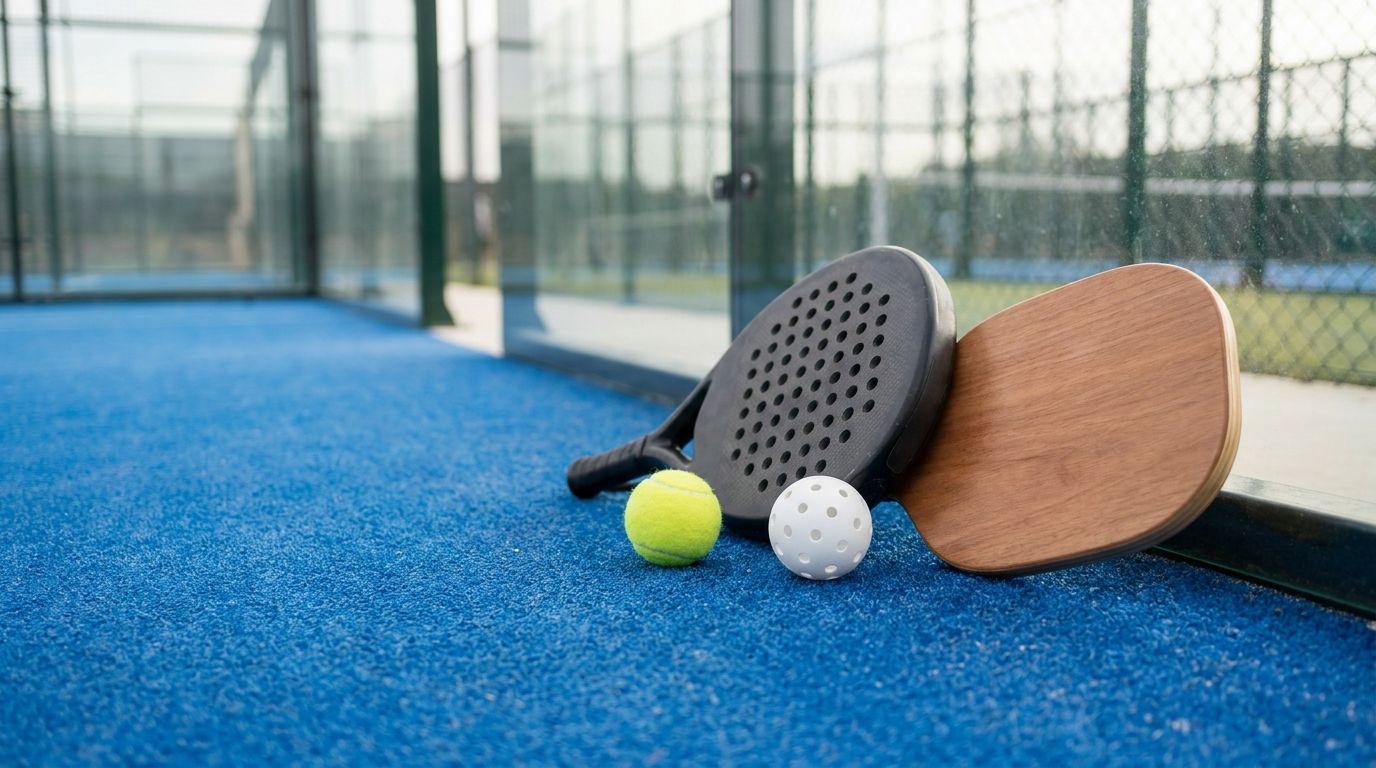
From the car park they look like the same idea twice: four players, a small court, an underarm serve and a lot of laughing. Then you walk inside and the resemblance falls apart. Padel is played in a glass box with walls you are supposed to use. Pickleball is played in the open, on a court the size of a badminton doubles court, with a rule that forbids you from volleying anywhere near the net.
Both sports came out of improvised games in the 1960s, both are usually doubles, and both are friendly to beginners. That is why the difference between padel and pickleball trips up so many new players. It comes down to three things: the enclosure, the gear, and what happens in the six feet around the net.
Two sports, two very different footprints
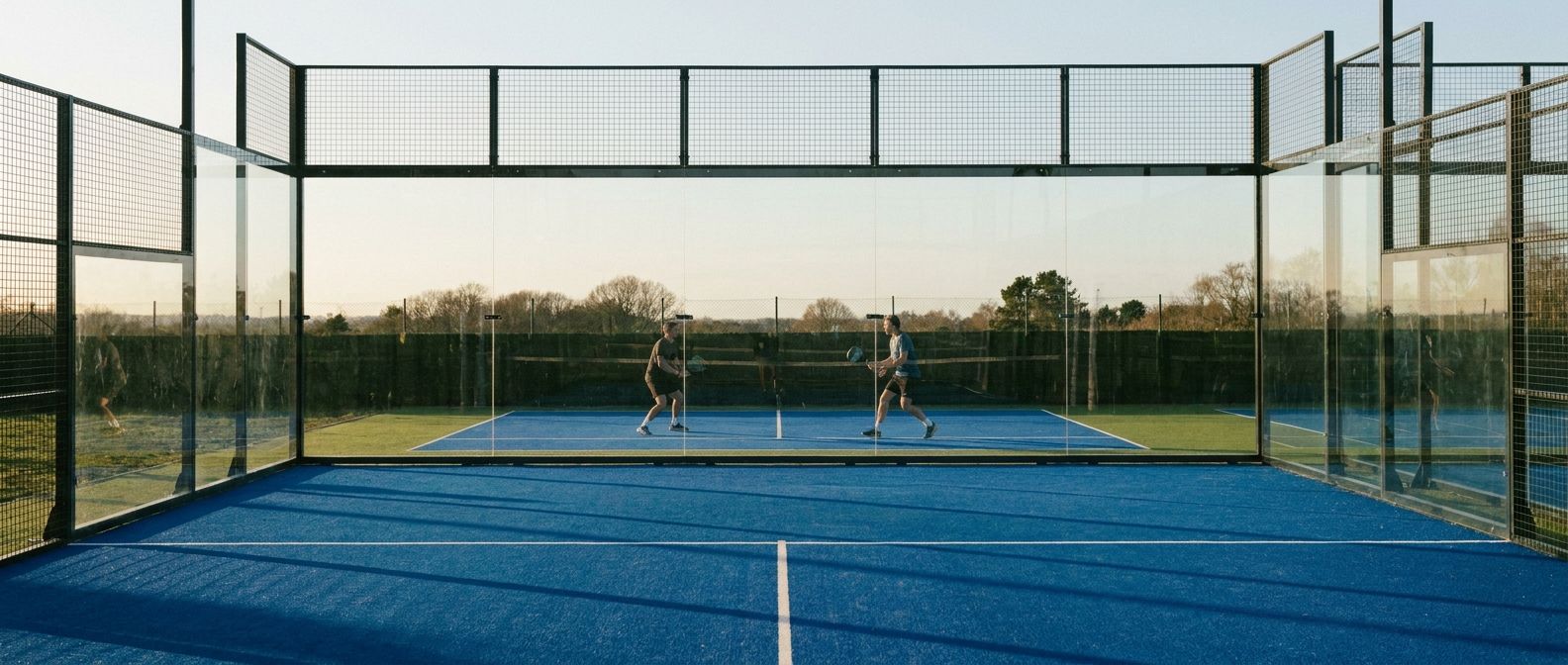
A regulation padel court measures 20 metres by 10 metres inside the walls, roughly 200 square metres of playing surface. The back walls stand four metres high, with three metres of glass topped by a metre of mesh, and the side walls step down towards the net. The net is 88 centimetres at the centre and 92 at the posts. Everything is enclosed, and the doors on each side are part of the game.
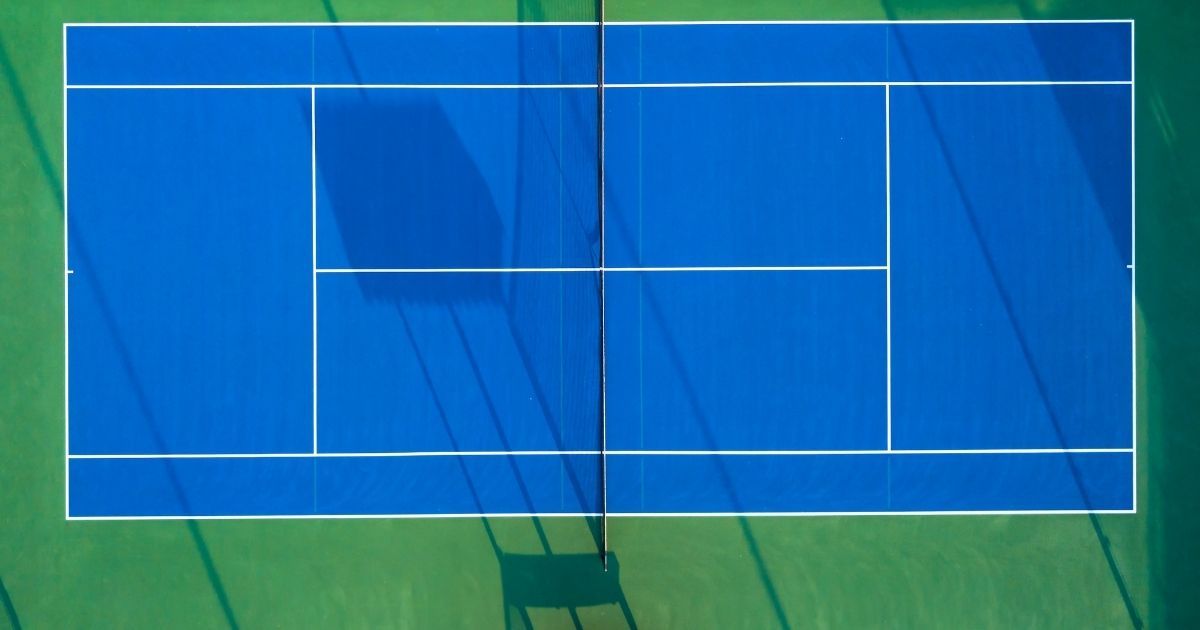
A pickleball court is 20 feet by 44 feet, or about 6.1 by 13.4 metres. That is the same footprint as a doubles badminton court, and it is less than half the area of a padel court. The net is 36 inches at the posts and 34 inches in the middle, and there is nothing around the edges except a painted line and, if you are lucky, a fence some distance away.
That single difference in geometry explains most of what follows. Padel is a game of angles in a closed room. Pickleball is a game of patience in an open rectangle.
The walls change everything
In padel, after the ball bounces on your side you can play it off the glass behind you or the mesh beside you. A good lob is not a defensive shot that ends the point; it is a setup, because your opponents have to chase the ball into the corner and deal with the rebound. Smashes that bounce out of the court are legal, and players run through the side doors to keep a rally alive.
In pickleball there are no walls. A ball that bounces past you is simply gone, and the only structure is the net. Instead of learning rebounds, you learn to control height. Most points are won by the team that keeps the ball low over the net and forces the other side to hit up.
The first hour of padel feels chaotic for exactly this reason: a ball sails over your head, you turn around, and it is coming back off the glass at an angle you did not expect.
The kitchen and the volley
Pickleball has one rule that shapes every rally: the non-volley zone, universally called the kitchen, extends seven feet from the net on both sides. You may stand there, and you may hit a ball there after it bounces, but you cannot volley while any part of you, your paddle or your momentum is touching the kitchen or its line. The two-bounce rule adds to it: the serve must bounce, the return must bounce, and only then can anyone volley.
Together those rules push players to the kitchen line, where the soft game happens. Dinks, resets and sudden attacks from short range decide most points above beginner level.
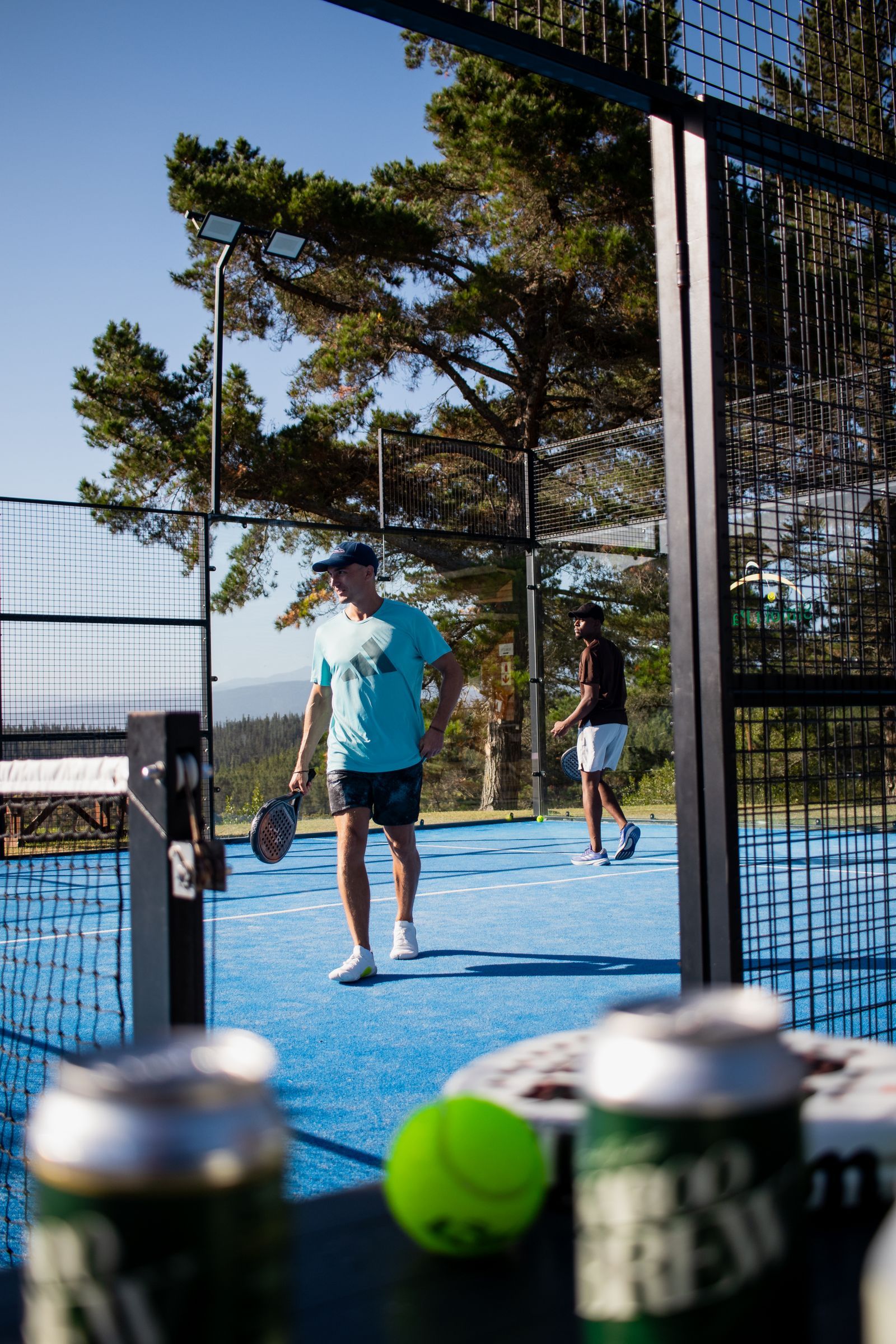
Padel has no equivalent zone. You can volley anywhere, including right on top of the net, and the glass gives you a second way to defend. What padel does restrict is the serve return, which must be played after the bounce. Beyond that, the net is a place to attack rather than a line to respect.
Rackets, paddles and balls
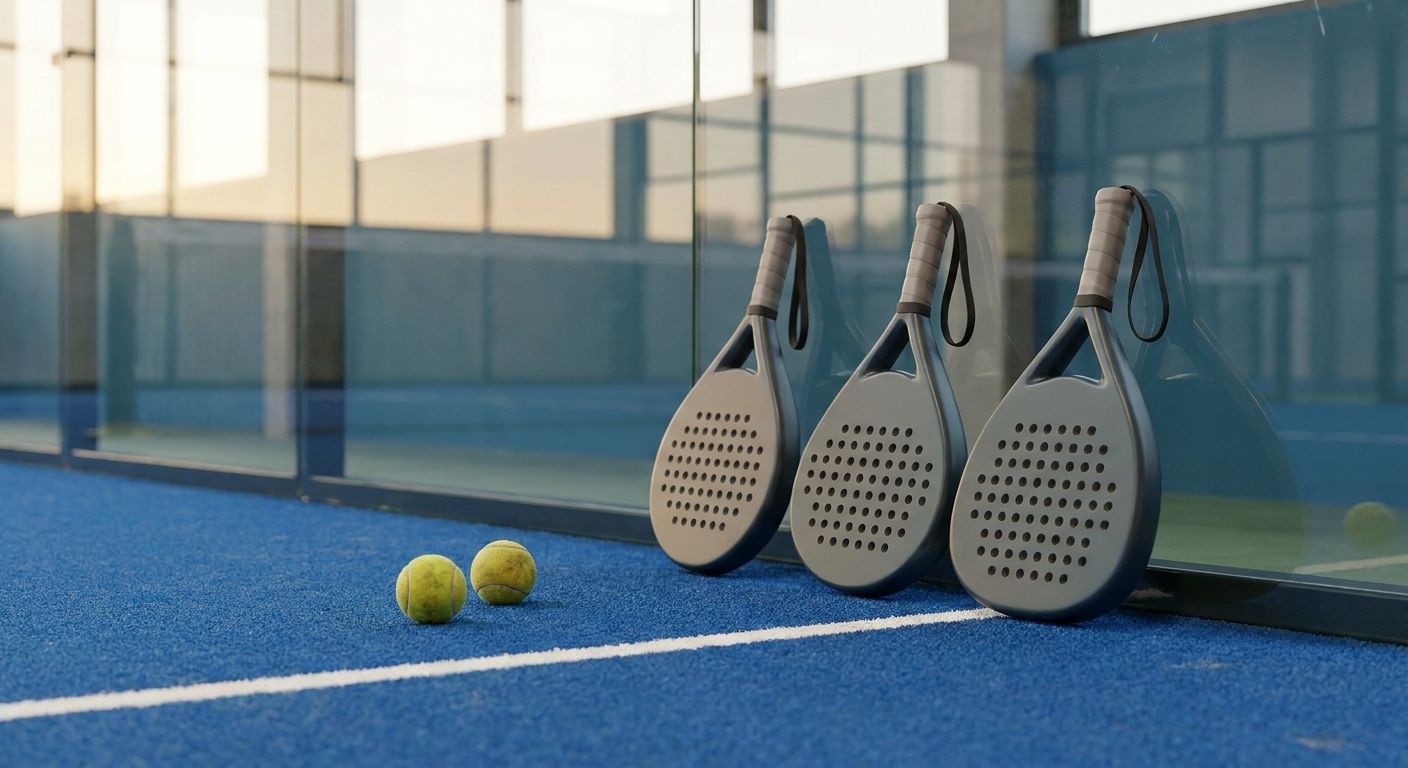
A padel racket, usually called a pala, has no strings. It is a perforated foam core with a flat hitting surface, and the rules cap it at 45.5 centimetres long, 26 centimetres wide and 38 millimetres thick, with holes between 9 and 13 millimetres across. A cord fixed to the handle must be looped around your wrist every time you play.
A pickleball paddle is solid, usually wood, composite or honeycomb core, with no holes in the hitting surface. USA Pickleball limits the combined length and width to 24 inches, with the length itself capped at 17 inches.
The balls are just as different. A padel ball looks like a tennis ball because it basically is one, built to slightly lower pressure: FIP rules set the diameter at 6.35 to 6.77 centimetres, the weight at 56 to 59.4 grams, and the bounce at 135 to 145 centimetres when dropped from 2.54 metres. A new padel ball sits around 11 psi against roughly 14 psi for a tennis ball, which is why it feels slower and easier to control.
A pickleball is a perforated plastic ball. It does not bounce much, it does not slow down much in the air, and it rewards a flat, compact swing. If you are weighing a padel ball versus a pickleball, the practical answer is that you cannot substitute one for the other: the plastic ball will not rebound off glass the way padel depends on.
Serving and scoring side by side
Padel serving is underarm, but it is not a dink. You bounce the ball on the ground behind the service line, which sits 6.95 metres from the net, and strike it at or below waist height, sending it diagonally into the opponent's service box. You get two attempts, and a serve that clips the net and lands in is a let. Scoring follows tennis: 15, 30, 40, game, with deuce and advantage, six games for a set, best of three sets. Many professional events replace advantage with a single deciding point, the golden point.
Pickleball serving is also underarm and also diagonal, but you get one attempt, and the ball must clear the kitchen as well as the net. Only the serving team can score. Games go to 11 and must be won by two, and in doubles the server calls three numbers before each point: their score, the receivers' score and whether they are the first or second server.
Padel borrowed tennis scoring wholesale, including its habit of letting a single game run ten minutes. Pickleball built a scoreboard that keeps matches short and lets a club rotate four courts in an evening.
How each sport feels to a beginner
Padel has a steeper first hour and a faster third session. The walls are disorienting, the ball comes at you from angles you have never practiced, and positioning matters more than shot quality. Once the rebound starts to make sense, the game opens up quickly, because the glass does half the defending for you.
Pickleball gives you a rally in the first five minutes. The court is small, the ball is slow, and anyone with a racket background can keep it in play. The hard part arrives later, when you meet players who never lift the ball.
Which one fits your week
Pickleball wins on access almost everywhere, especially in the United States and Canada, where courts have multiplied in parks, schools and converted retail units. A paddle and a pair of trainers will get you started, and most clubs run open sessions where a newcomer can join a rotation.
Padel needs a purpose-built enclosure, so courts are concentrated in clubs and cost more per session, and a 200 square metre court with out-of-court retrievals is a genuine workout. In return you get a game that feels more athletic and tactical, plays well indoors in bad weather, and comes with a strong club culture.
Where the two sports stand right now
The numbers are not really comparable, but both are striking. The Sports & Fitness Industry Association reported that 24.3 million Americans played pickleball in 2025, up from 4.2 million in 2020, a fifth straight year as the country's fastest-growing sport. The same 2026 report added padel as a tracked activity for the first time.
Globally, the FIP World Padel Report published in October 2026 estimates more than 40 million amateur players, 91,234 courts after a 20.4 percent increase in a year, and organised play in 191 countries and territories, with women making up 47 percent of participants. Those figures count everyone who played at least once in the past year, so they sit on a different basis than SFIA's survey.
Can you play both?
Yes, and most people who try one end up trying the other. Coming from pickleball to padel, your net instincts will serve you well, and your patience at the kitchen line translates into good positioning. What you have to unlearn is the flat, punching swing: padel rewards a fuller stroke and a higher contact point, and you need to trust the glass.
Coming from padel to pickleball, the adjustment is discipline. There is no wall to save you, the court is smaller than you think, and the kitchen line will punish the instinct to close in and volley.
The short answer
Padel is a walled court game with stringless rackets, tennis scoring and two serves, where the glass does as much work as your racket. Pickleball is an open court game with solid paddles, a plastic ball, side-out scoring to 11 and a seven-foot no-volley zone that makes the net a place of restraint.
If you want the easier entry and the wider choice of courts, play pickleball. If you want angles, rebounds and a more physical evening, find a padel club and book an hour with a coach. Either way, the confusion disappears the first time a ball comes back off the glass.