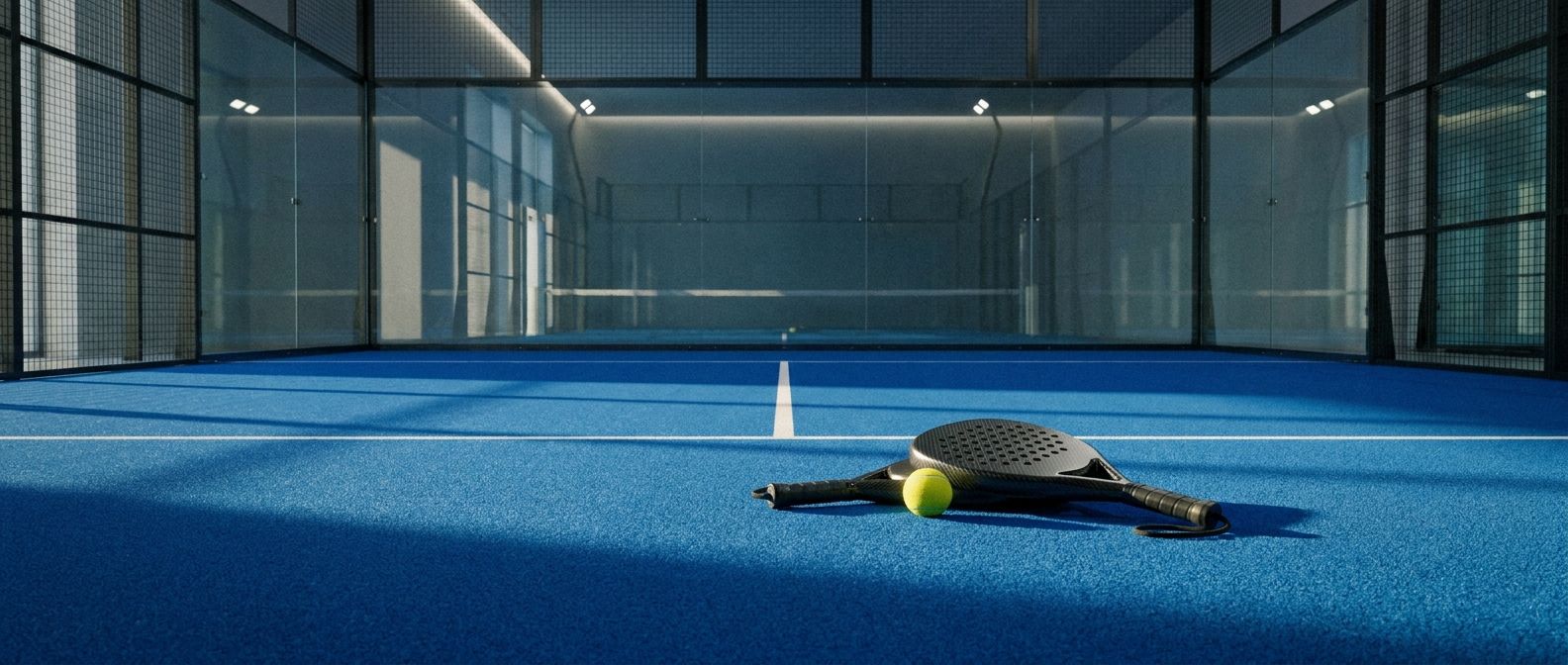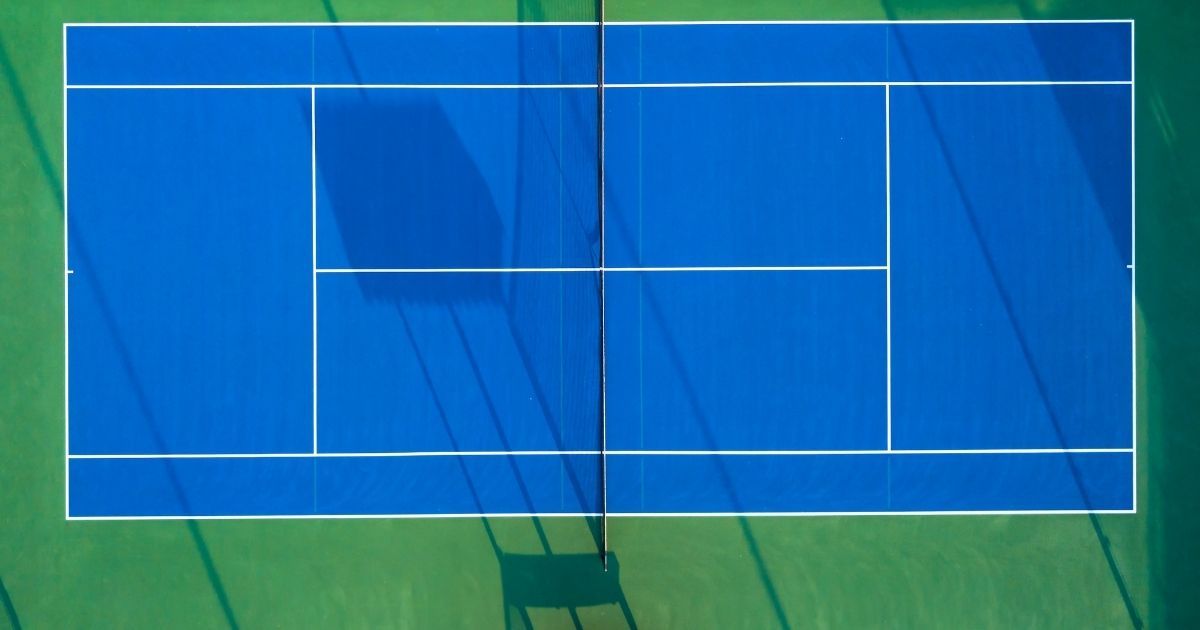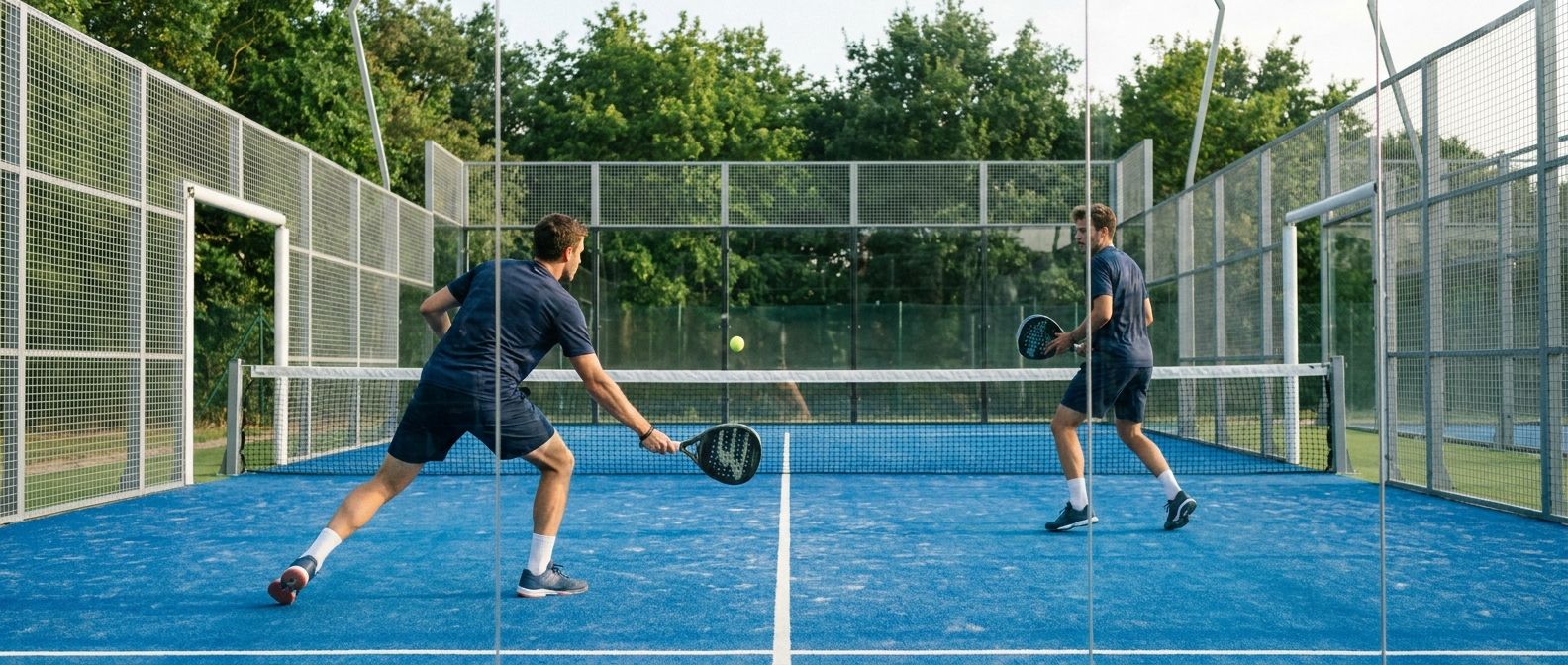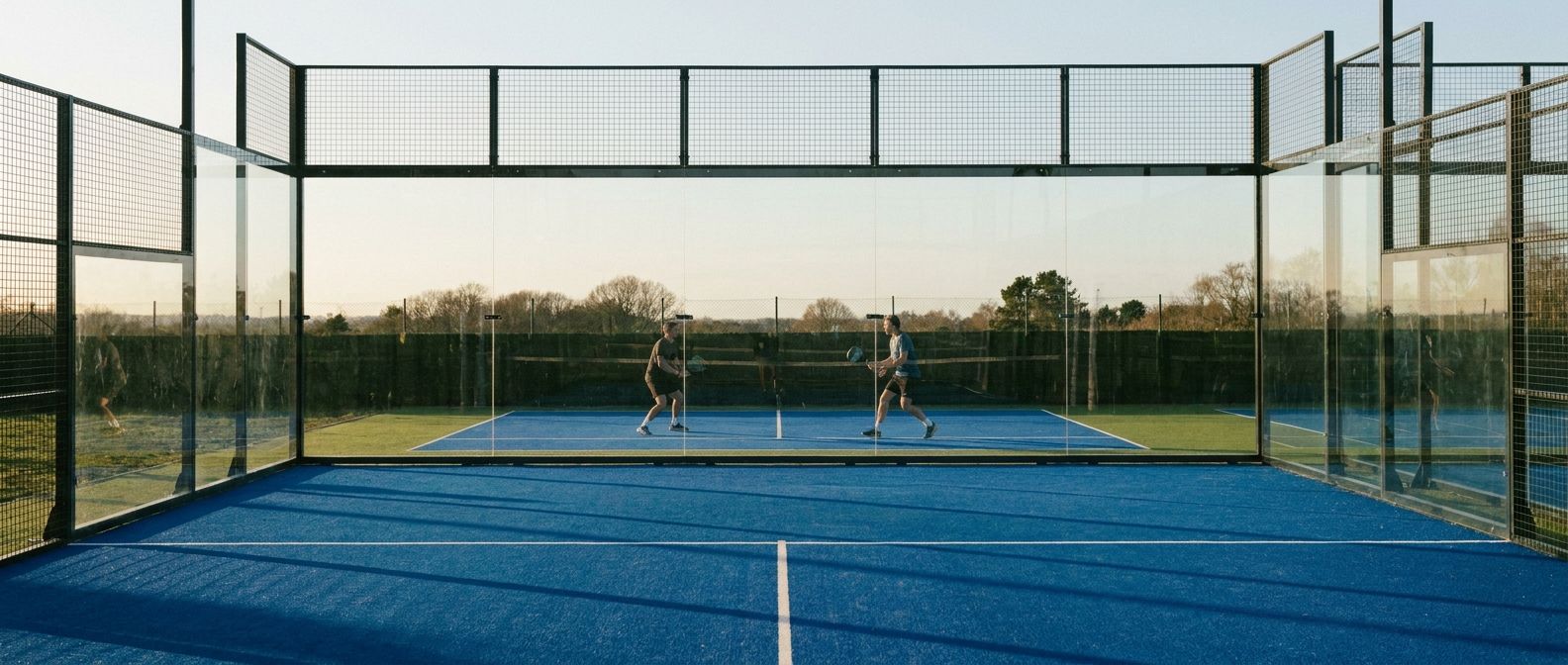
Padel looks like a scaled-down tennis court with glass around it, so most newcomers assume the rules are just tennis rules over shorter distances. Then a shot comes off the back wall, lands behind them, and they stand frozen while their partner chases it down. The walls are not decoration and they are not out of bounds. They are the reason the game plays the way it does. A handful of rules about walls, bounces and faults will make your first few matches far less confusing, and a good deal more fun.
The walls are in play, not out of bounds
The single biggest adjustment for new players is this: on your own side of the court, the glass and mesh walls are part of the playing area. When a shot reaches you, it can bounce on the floor and then rebound off the back or side wall, and it is still live. You are expected to play it. The wall is a tool, not a boundary you defend.
On most courts the back wall is glass for its full height, while the side walls are glass at the lower section with mesh above. Both surfaces keep the ball in play. What matters is where the ball first landed. If it bounced inside the court, everything that happens against the walls afterwards is legal.
One bounce on your side, and only one
Padel gives each player the same basic allowance as tennis: the ball may bounce once on your side before you have to return it. Let it bounce a second time and the point is over, against you. The wall changes when that second bounce can arrive, and that is where the confusion starts.
Picture a lob landing deep near the glass. It bounces on the floor, hits the back wall and comes back toward you. You still get that rebound; you have not used up your bounce. But if the ball then touches the floor a second time before you reach it, you have lost the point. The wall buys you time, not extra bounces.
The glass and the fence do different jobs
Players new to the sport often treat the two surfaces as one. The glass gives a clean, predictable rebound: the ball comes off it fast and low, at an angle you can read once you have seen it a few times. The mesh or fence section above and beside it behaves quite differently. A ball that reaches the mesh tends to die and drop rather than kick back out, which can make it trickier to judge under pressure.
Neither surface makes the ball out. The only thing you need to track is the floor. If the ball touches the ground outside the lines, the wall standing behind it will not save it.
When the ball is actually out
A ball is out when it lands on the floor outside the boundary lines, or when it hits the fence or an object beyond the court without bouncing in first. It is not out simply because it touched a wall. This trips up beginners who stop playing the moment the ball heads for the glass, assuming the rally is finished.
The short version is to judge the landing, not the wall. If it lands in, keep playing. If it lands out, the point is over and it is time to reset.
Playing off your own back wall
Once you accept the walls, you can start using them. The most useful skill for a club player is letting a deep ball travel to the back wall and simply turning to play it on the rebound. Instead of scrambling to hit the ball before it reaches the glass, you move back, give it room and make contact as it comes off the wall toward you.
It feels counter-intuitive at first, because most players are taught to attack the ball early. But on defence the wall is an ally. It holds the ball for you, and a calm player who reads the rebound will retrieve shots that look hopeless from the baseline. The players who look calm under pressure are usually just reading the wall a fraction early.
You can volley, but not before the ball crosses
You do not have to wait for a bounce. You can hit the ball out of the air, and most points at the net are won that way. The rule to remember is where you may make contact. You cannot reach over the net or strike the ball before it has crossed to your side. Reaching across to smash a ball that is still on your opponents' side is a fault, even if the contact itself would have been legal. Playing the ball after it crosses, whether in the air or off the wall, is perfectly fine.
Faults that catch out new players
Beyond bounce and boundary rules, a few smaller rules decide points more often than you would expect.
- Touching the net. If you or your racket touches the net, the post or the net band while the ball is in play, you lose the point.
- The ball hitting you. If the ball touches your body rather than your racket after it has been played, the point goes to your opponents. Play it with the racket, not your shin.
- Hitting the ball twice. A clean, single contact is required. Accidental double touches are usually called against you in competitive play.
- Carrying the ball. The ball must be struck, not caught or guided along the racket face.
None of these are meant to be cruel. They exist because padel is fast, the walls put the ball in unexpected places, and a clear rule is fairer than a debate.
The serve and scoring, briefly
The serve is underhand and must be struck below waist height, and it has to land in the diagonally opposite service box. From there the ball may carry on into the side wall. A serve that misses the box, or clips the net and lands out, is a fault; two in a row and you lose the point.
Scoring follows tennis, with fifteen, thirty, forty and game, and a tiebreak to settle a set. Many club games use a golden point at deuce, where the receiving pair chooses which side to return from, and matches are usually best of three sets. Every court seems to have its own house rules on formats, so it is worth asking before you start.
The etiquette around the rules
Padel is a social game, and much of the rules culture exists to keep it fair without a referee. Call your own balls honestly, including the ones that are out against you. Say the score before every point so nobody has to guess. When a ball is close, most club players give their opponents the benefit of the doubt.
If you are genuinely unsure whether a ball bounced twice, ask rather than argue. The culture rewards a fair opponent as much as a good one, and you will get more invitations to play if you are easy to share a court with.
Why the rules reward patience
Beginners tend to play padel like tennis: hit hard, finish the point early, avoid the walls. The rules push you the other way. Because the ball stays alive off the walls and you get only one bounce, rallies last longer than newcomers expect, and the player who stays calm and keeps the ball in play usually wins.
Learning to read the rebound, to back off and use the wall, and to wait for a high ball you can attack will improve your results faster than adding power. The rules are not obstacles to work around. They are the reason the game is won with patience.
None of this takes long to absorb once you have played a few sets. Watch where the ball lands, remember that the walls are your ally on defence and a puzzle on attack, and keep your contact clean. The rest, the lets, the calls and the golden points, you will pick up simply by playing. Ask an experienced partner to talk you through your first match; most are happy to, and it is the quickest way to stop feeling like the walls are working against you.