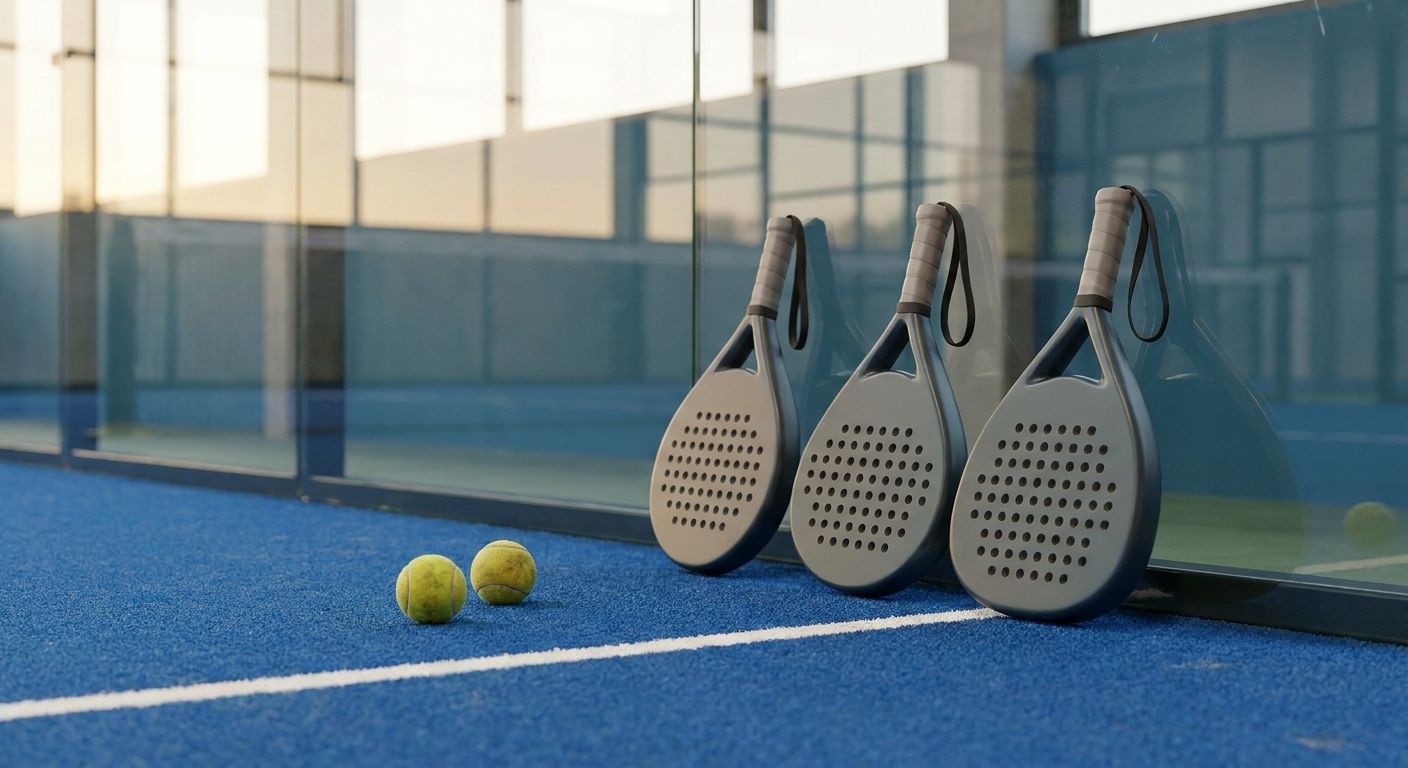
The new frame always feels wonderful in the shop. It is a few grams lighter than yours, the face still grips, and the balance makes it swing like something built for you personally. Then you play three sets and the score looks exactly as it did last week. That is not an argument against upgrading, but it is an argument for knowing what you are paying for. Between a starter frame and a serious club frame the real differences change how a racket feels long before they change how you play.
When a new racket actually helps
There are three honest reasons to replace a frame. Damage is the first: a hairline crack at the bridge, a rattle when you shake it, or a face that has gone soft and thuds instead of popping. The second is fit. If your forearm is tired after every session, or you feel a sting in the elbow on off-centre hits, the weight and balance may simply be wrong for your arm. The third is progress: a fibreglass starter frame flexes generously and hides mistakes, which helps a beginner and limits a player who now hits cleanly and wants the frame to answer.
What a new racket will not fix is late contact, a wristy backhand or poor positioning. Those cause most mishits at club level and they follow you into any frame you buy. If your shots break down because you arrive a step late, spend the money on court time instead.
What the rules fix, and what brands can change
Padel rackets are tightly regulated, which is worth knowing before you compare spec sheets. Under the international rules a racket may be no longer than 45.5 cm from the base of the handle to the top of the head, no more than 26 cm wide and no thicker than 38 mm, with a small tolerance allowed when a referee measures it. The handle is capped at 20 cm, the perforations in the hitting area must be between 9 and 13 mm, and a wrist strap is mandatory.
So every legal frame is roughly the same size. What differs is the outline within those limits, where the mass sits, and what the frame and core are made of.
Shape decides where the sweet spot sits
The outline is the first decision, because it sets two things at once: where the sweet spot is and where the weight wants to sit. A round racket is widest in the middle of the head, with a large central sweet spot and the mass low towards your hand, which makes it quick to move at the net and short of punch on overheads. A teardrop widens towards the top, with a smaller, higher sweet spot and a middle balance: enough forgiveness to defend, enough weight up top to finish a point. A diamond carries its widest point high and flat, with a small sweet spot near the tip where the weight also sits. Hit it cleanly and the ball leaves fast; miss it and you feel it.
Brands also sell “hybrid” shapes, which usually means a teardrop with a slightly flatter top. Read the label as marketing and look at the balance instead. Two rules of thumb are worth keeping. If you cannot choose between a teardrop and a diamond, take the teardrop, which is good enough to attack with at any club level. And very few players should jump straight from a round frame to a diamond.
Weight and balance: the numbers worth reading
Most adult rackets are listed between about 350 and 375 grams, with light and women’s versions typically 10 to 15 grams below the standard model. Brands quote a range rather than a single figure because two frames from the same mould can differ by a few grams.
Balance matters more. It is measured from the butt of the handle to the point where the racket sits level, so it tells you whether the mass is near your hand or out in the head. A 2022 study of 137 rackets published in the journal Sensors found balance points from 246 to 283 mm, averaging about 265 mm, and weights from 316 to 387 grams. The entire market therefore lives inside a 4 cm window of balance, and that window is the difference between a frame that feels nimble and one that feels like a hammer.
Low balance turns fast on volleys and defence and is kinder to the arm. High balance gives more momentum on the smash and the vibora but slows your hands in the middle of the court and loads the wrist. Two accessories quietly change what you thought you bought: a frame protector adds roughly 5 to 10 grams at the head and shifts the balance upwards, while an overgrip adds a little weight at the handle and tugs it the other way. As a starting point, 355 to 370 grams with low or even balance covers most intermediate needs, and if you are torn between two weights, take the lighter one.
Core and face: what soft EVA and the K number mean
The core is the foam inside the head. Hard EVA is firmer and denser: it returns energy quickly, feels dry on contact and rewards a full swing, but punishes mishits and is harder on the arm. Soft EVA cushions the ball, gives easier depth on defensive shots and takes the sting out of off-centre contact, at the cost of some top-end power and usually some durability.
The face is where the marketing gets loudest. The number in 3K, 12K or 18K carbon refers to how many thousand filaments make up each thread in the weave. It is not a quality ladder. A tight 3K weave tends to feel firm and dry, 12K is the common middle ground, and a more open 18K weave can feel livelier and more elastic. Makers pair weaves with core hardness deliberately, so judge the combination rather than the badge. Entry frames often use fibreglass, which flexes more and is less durable, but is gentler and cheaper: moving from fibreglass to carbon is one upgrade you can genuinely feel in ten minutes.
Match the frame to the side you play
In padel you and your partner are not doing the same job. The right-side player spends more time driving, defending and covering the middle, so a low or even balance keeps the hands quick and the arm fresh. The left-side player attacks more, hits more smashes and covers the backhand volley, which is where a little extra mass in the head earns its keep. If you play both sides, or you are not sure yet, a teardrop with medium balance is the safer purchase.
What upgrading looks like at club level
A recent survey of 188 adult rackets on sale at European retailers put the median price of a beginner-tagged frame at about €75, most between €70 and €90, with the majority round in shape. Intermediate frames had a median near €143, most between €108 and €170, with round, teardrop and diamond almost equally common. Advanced frames had a median around €191, most between €160 and €230, and roughly half of them diamond.
The jump from entry to intermediate pays for construction: a carbon face, a better core, a frame that will not go soft in a season. The jump from intermediate to advanced pays for a smaller sweet spot, more mass up top and a frame that assumes you already hit the ball in the right place. The best value is rarely this year’s flagship. Last season’s top model at a discount, or a well-kept used frame from a player who upgrades every year, gets you the same construction for less. Check the bridge and the frame edge for hairline cracks, shake it to listen for a rattle, and press a thumb into the face to feel whether the core still has life.
Ten minutes of testing before you buy
If the shop or a teammate will lend you a frame, use the time properly. Hit twenty balls of four shots: a low volley at the net, a bandeja, a defensive lob off the back glass, and one full smash. Then ask three questions. Did the racket turn in my hand? Did the off-centre hits die, or still travel? Did my arm notice the weight after five minutes? Check the grip with your overgrip already fitted, and confirm the wrist strap is attached and comfortable, which is both a rule and common sense.
Look after it and it will last
A padel racket is foam, resin and carbon, and all three dislike heat. Leaving it in a car on a sunny afternoon softens the core and stresses the resin. Keep it in a bag, out of direct sun. Avoid tapping the frame against the glass or the fence between points: it looks harmless and it is the most common way a frame picks up the small cracks that eventually become a broken bridge.
A frame is finished when it thuds rather than pops, rattles when shaken, or shows a crack where the head meets the handle. Until then, the cheapest upgrade available is a fresh grip and some honest practice. After that, buy the racket that matches how you actually play.