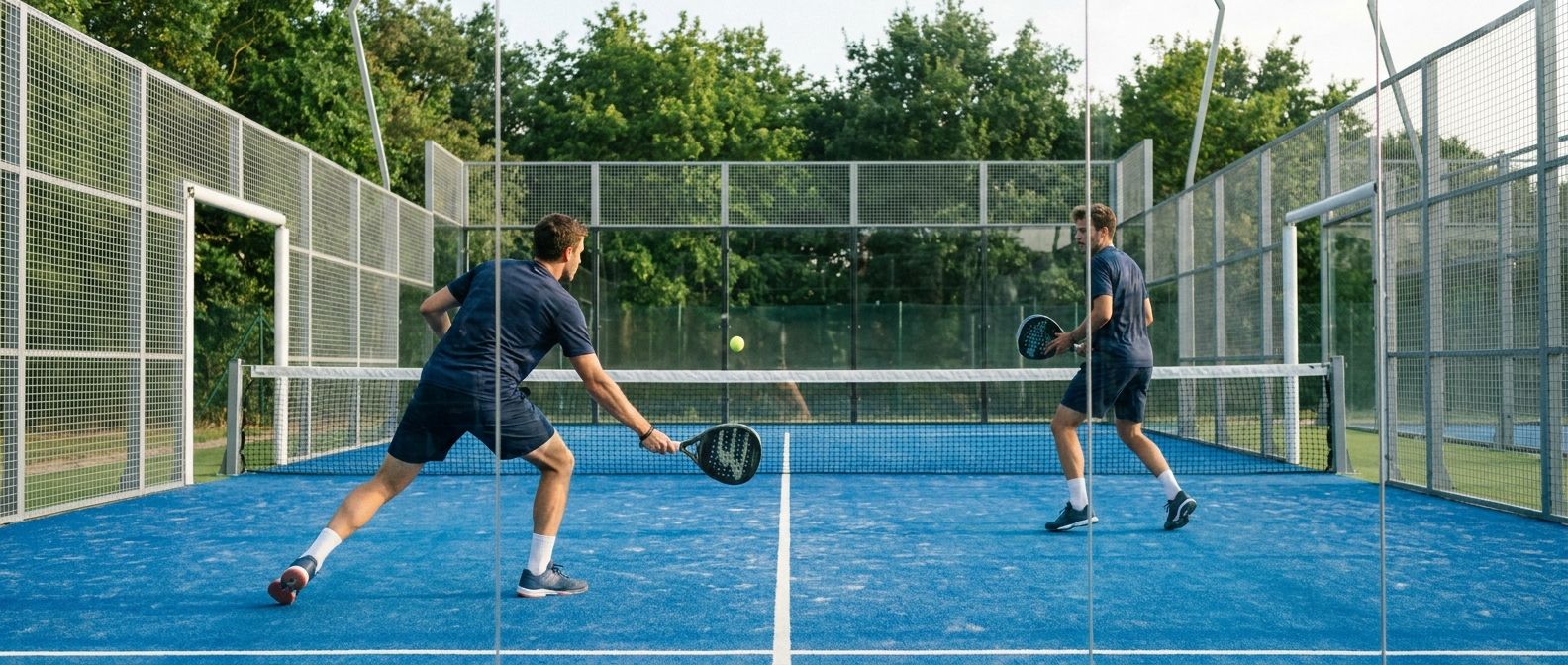
Most players learn padel in the same order: serve, return, rally, then the moment the ball hits the glass and everything they know stops working. The back wall turns a comfortable forehand into a scramble, and the side glass sends the ball somewhere the feet never expected.
The good news is that glass play is not a talent. It is a set of habits, and most of them are about position and patience rather than fast hands. Once you understand what the wall does to the ball, the shot that felt impossible becomes the one you look forward to.
The Glass Is a Teammate, Not an Obstacle
New players treat the back wall as a boundary to avoid. Experienced players treat it as a brake. When the ball hits the glass, it loses speed, drops lower and travels back toward the net at a predictable angle. That extra half-second is the whole point: it lets you move, set your feet and choose a shot instead of reacting in panic.
So the first tactical shift is mental. A ball heading for the back glass is not a lost point. It is a ball you are allowed to be late for. If you can internalise that, you stop lunging and start reading.
Where to Stand Before the Ball Arrives
Position solves most glass problems before they start. The mistake is standing flat against the back wall, where you have no room to swing and no time to adjust. Instead, work from roughly a metre to a metre and a half in front of the glass, with a slight sideways stance and your weight on the balls of your feet.
From there, a split step as your opponent makes contact buys you the first step in either direction. The player who is still standing upright when the ball leaves the racket is the player who gets beaten by the bounce, not by the shot.
A simple rule for the defensive pair: when the ball is deep and your opponents are at the net, both of you drop to a line about a metre off the glass. You are not retreating out of fear. You are creating the space to play the ball after it comes back.
Reading the Bounce Off the Back Wall
The back glass behaves differently depending on how the ball arrives. A ball with heavy topspin kicks forward and low after contact, so it stays close to the wall and demands a compact swing. A sliced or flat ball arrives softer, sits up slightly and gives you more time but a more awkward contact point near your ankles.
Watch the trajectory, not the ball. If the ball is still rising as it passes you, it will bounce off the glass and come back fast. If it is already descending, the bounce will be gentler and you can step in.
Two things follow from this. First, keep your racket up and your elbows in front of your body, ready for a short backswing. Second, do not swing at the wall's rhythm. Wait for the ball to come off the glass and travel to you, then meet it in front of your hip rather than beside it.
The Side Glass Changes the Angle
The side glass is where good defenders turn into difficult opponents. A ball that hits the side panel comes off at an angle across the court, usually toward the middle. That means the ball often arrives in the space between you and your partner, which is exactly where confusion lives.
Decide early who takes it. The usual convention is that the player on the side the ball is heading toward takes it, calling "mine" loudly and early. The partner rotates behind and covers the cross-court reply. If neither of you calls, both of you will swing, and that is how rackets get broken.
The side glass is also a gift when you are attacking. Hitting into the side wall on your opponents' side pulls them wide and opens the middle. It is a lower-percentage shot than a straight drive, so use it as a change of pace rather than a default.
The Exit Ball: Your Most Important Shot
The shot you play off the back glass is the one that decides whether the point resets or ends. Professionals call it the exit or the salida, and it is almost always conservative: a high, deep lob or a low, firm ball into the feet of the net player.
The lob is the safer choice. It gives you time to move forward, pushes your opponents back and turns a defensive scramble into an even exchange. The key is depth, not height. A lob that lands short of the service line is an invitation; a lob that lands within a metre of the back glass is a problem for the other team.
The alternative is the chiquita, a low ball played with soft hands into the feet of the player at the net. It is harder to execute but keeps you at the net instead of sending you back. Most club players should build the lob first and add the chiquita once the lob is reliable, because a bad chiquita is a short ball and a short ball is a smash.
Turning Defence Into Attack
The transition from defence to attack in padel is rarely a single heroic shot. It is usually two or three shots that move you forward: a deep lob, a step into the court, then a volley or an overhead from a better position.
When your opponents lob and the ball lands short, you have a choice between the bandeja and the vibora. The bandeja is the flat, sliced overhead played with the racket moving from high to low, contacting the ball slightly in front and to the side. It keeps the ball low, buys you time to approach the net and is the percentage shot for most club players.
The vibora is faster and more aggressive, with more side spin and a lower, skidding trajectory. It is also less forgiving: mistime it and the ball sits up for your opponents to attack. Use it when you are balanced, when the ball is in your strike zone and when you have already earned the net position.
Neither shot should be confused with the smash. Flat smashes off a high, short lob are spectacular and occasionally effective, but at club level they are often returned off the glass and put you in a worse position than a well-placed bandeja would have.
Win the Middle, Not the Lines
The most common tactical error in club padel is trying to win points down the line. The lines are the lowest-percentage targets on the court, and the middle is where most points are actually decided.
Two reasons. First, a ball through the middle forces the opposing pair to communicate and decide who takes it, and club pairs are often slower at that than they are at covering their own side. Second, the middle gives you the widest range of angles: from the centre you can play to either side glass, and your opponents have to cover more court.
That does not mean hitting everything down the middle. It means using the middle as your default target and the lines as the exception, when you have pulled an opponent out of position.
Covering the Court as a Pair
A padel pair should move like a single unit, sliding sideways rather than crossing over. When the ball goes to your partner's side, you do not stand still and watch: you shift toward the middle, close the gap and prepare for the cross-court reply.
The player on the forehand side usually takes the middle ball, because the forehand is the more natural shot to play into the gap. Agree on this before the match rather than during a point. A short conversation at the changeover saves a dozen confused rallies.
Equally important is what happens when you are at the net and the ball goes over your head. Both players turn and retreat on a diagonal, not straight back, so you arrive at the glass in a position to play rather than flat-footed against it.
Three Drills That Actually Transfer
You do not need a coach to build glass confidence. Three drills cover most of it.
The first is a simple wall rally. Stand a metre and a half from the back glass, hit the ball into the wall and play the rebound. Keep the ball low, use a compact swing and count how many consecutive controlled shots you can make. Twenty is a good target for a club player.
The second is the two-bounce rule. During a practice rally, force yourself to let every deep ball bounce off the glass before you play it. It feels passive at first, but it teaches you to wait and to read the rebound instead of attacking balls you should defend.
The third is the lob-and-close pattern. Lob deep, move to the service line, then play a bandeja off the return and move to the net. Repeat it until the sequence is automatic. This one pattern covers more match situations than any other combination in the sport.
Putting It Together
Glass play rewards the player who is willing to be patient for one extra second. Stand a metre off the wall, split step as your opponent swings, let the ball come off the glass and answer with depth rather than power. Then use the middle of the court, move as a pair and take the net only when the ball genuinely allows it.
None of this requires a new racket or a faster swing. It requires deciding, before the point starts, that you will not fight the wall. The players who look calm on the glass are not faster than you. They are simply standing in the right place, waiting for a ball they already know is coming.