Your hand is the only part of you that touches the racket, yet the grip is the last thing most club players think about. We obsess over the frame, the ball and the shoes, then play with a slick, worn wrap that twists in the palm on every volley. A padel grip costs little, takes a couple of minutes to change and is one of the fastest ways to make a racket feel like it belongs to you. If your racket has ever turned in your hand on a smash, or felt heavier and slippier in the last game of the night, the fix may already be waiting in a small packet at the club shop.
Base grip and overgrip are not the same thing
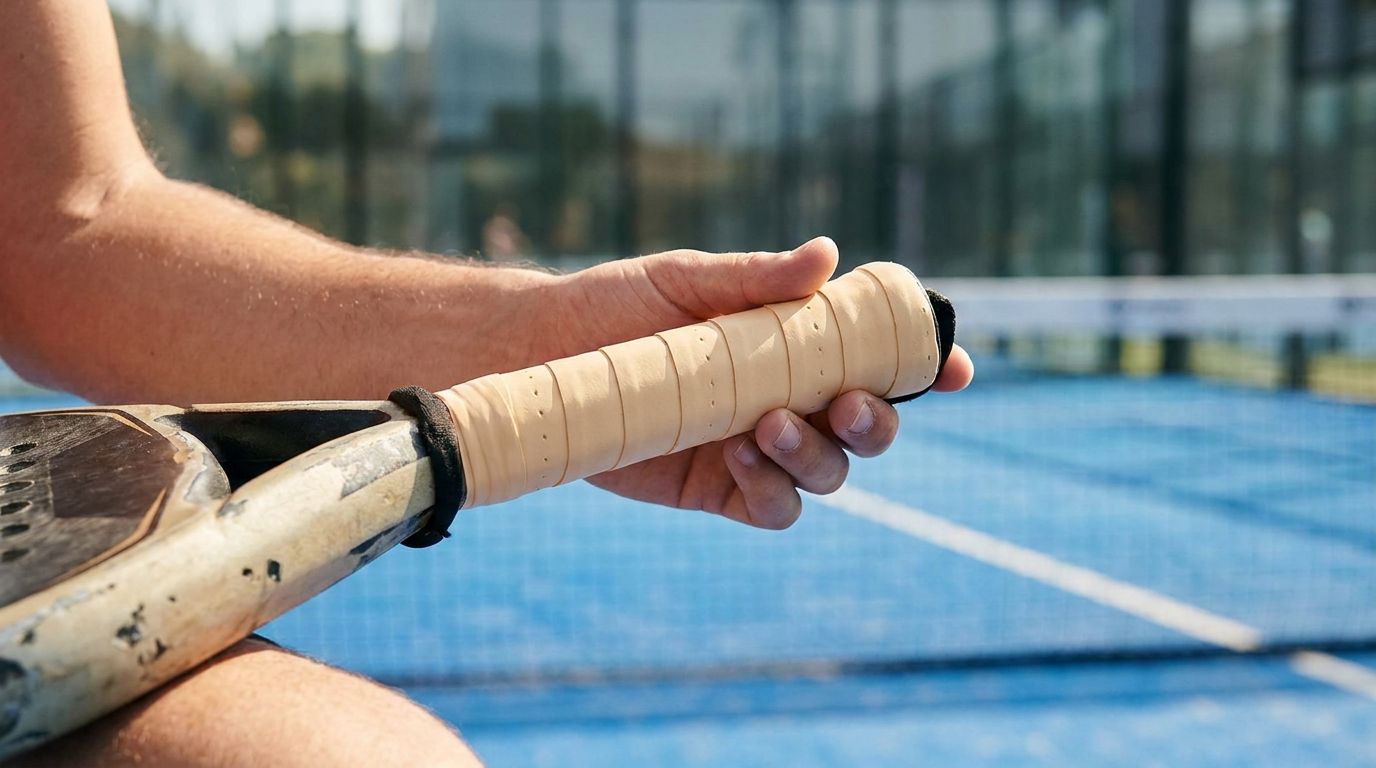
Every padel racket arrives with a base grip: a thicker, cushioned layer wrapped directly onto the handle. It sets the size and shape of the handle, and it is built to stay on for months. An overgrip is different. It is a thin, replaceable strip that you wrap over the base grip. Its job is to absorb sweat, fine-tune the feel and take the wear so the base grip underneath lasts longer. In practice, the overgrip is the part you refresh every few sessions, while the base grip changes rarely. Confusing the two is the most common reason players keep holding a handle that gave up long ago.
What your hands are telling you
Hands differ, and so do grips. If you sweat heavily, look for an absorbent “dry” overgrip that soaks up moisture and stays matte; a smooth, glossy wrap will simply slide once your palm gets wet. If your hands stay dry, a tacky overgrip with a slightly sticky surface offers more bite and a firmer hold. The signals are easy to read. You are gripping too hard if your forearm aches after a session, if you notice the racket rotating on off-centre hits, or if you catch yourself re-clenching between points. Most of the time that is not a technique fault. It is the grip failing to do its job.
Grip size matters just as much. A handle that is too thin forces you to clench to keep control; one that is too thick robs you of wrist freedom and makes it harder to whip through the ball. You can adjust the feel without changing rackets by adding or removing an overgrip, or by switching between a thin and a thick one. Most adult club players end up somewhere in the middle, and the right answer is simply the one that lets your hand relax.
Thickness, tack and texture
A padel overgrip is usually labelled by thickness. Thin wraps, around half a millimetre, keep you close to the base grip and suit players who want direct feedback. Thicker wraps of a millimetre or more add cushioning and are kinder to hands that bruise or blister. Beyond thickness, look at the surface. Perforated or punched grips have small holes that let air and moisture through, which helps in a warm hall. Ribbed or textured grips add a little friction for dry hands. None of these is better in the abstract; the right choice depends on your palm, the climate and how the handle already feels.
Hesacore grips and the perforated-core idea
One product worth knowing is the Hesacore grip, which replaces the standard base grip with a layer built from a honeycomb of hexagonal holes. The design goal is simple: let your fingers settle into the gaps so the surface meets more of your hand and you need less pressure to hold on. Players who like it often say their grip feels more secure with a lighter hold, which can be welcome on long rallies or in the heat. It does change the feel of the handle, though, so give it a session or two before deciding. It is a clear example of how much a grip can shape the way a racket plays.
How to wrap an overgrip
Wrapping a grip is easier than it looks, and once you have done it twice it becomes a two-minute job.
Start clean. Peel off the old overgrip and wipe away any sticky residue, then let the base grip dry or towel it off. A damp handle will trap moisture under the new wrap.
Begin at the butt cap and work upward toward the throat. Peel the backing a little at a time so the strip does not curl back on itself, and hold steady tension as you go.
Overlap each turn by about a third. This gives you a smooth surface with no gaps and no raised ridges that could catch your fingers. Follow the direction your hand rolls when you close it, so the overlapping edges lie flat against your palm.
Finish at the top with the supplied finishing tape and trim any excess cleanly. Check the wrap by running your thumb along it: you want an even, comfortable surface, not a spiral of bumps.
When to replace a grip
An overgrip has a short life. It is finished when the surface goes shiny and slick, when the edges begin to lift or curl, or when it has compacted into a hard, glossy band where your palm sits. As a rough rhythm, most regular players change an overgrip every three to five sessions, and more often in summer or if they sweat heavily. Keeping a spare in your bag means you never have to play a second session on a dead grip.
The base grip lasts longer. Replace it when it feels flattened, when the handle underneath starts to show through, or when it no longer cushions your hand. If you play several times a week, changing it once a season is a sensible habit.
Grip, comfort and the long session
Grip pressure is one of those things players rarely notice until it changes. Hold the racket too tightly and the forearm tightens, the wrist locks and the swing shortens. A grip that lets you hold the handle loosely, without fear of it slipping, keeps the arm relaxed through a long rally. That is why comfort and control are two sides of the same choice. A wrap that suits your hand quietly supports your technique; the wrong one quietly works against it.
It is also worth paying attention to how the handle feels when you are tired. The last game of a session is where a tired grip shows itself: the racket feels heavier, returns sit up short and you begin to guide the ball instead of swinging at it. A fresh overgrip will not fix fitness, but it removes one small reason for a tired arm to give in.
Small maintenance, real payoff
A grip is one of the cheapest parts of the kit and one of the most personal. Getting it right helps you hold the racket loose enough to swing freely, keeps the handle from twisting on quick exchanges and makes long sessions easier on your arm. It also helps in smaller ways: a clean, dry grip is more hygienic, and it makes passing your racket around during a social game a little more pleasant for everyone.
Try one small experiment this week. Match your overgrip to your hands and the season, wrap it with even tension, and replace it when it stops doing its job. You will likely notice more control and less effort, for the price of a packet of overgrips.